
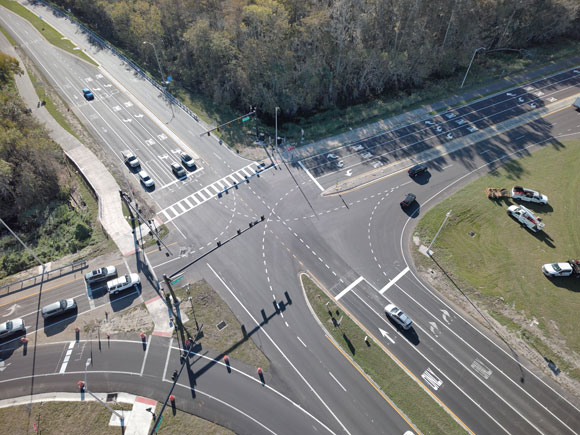
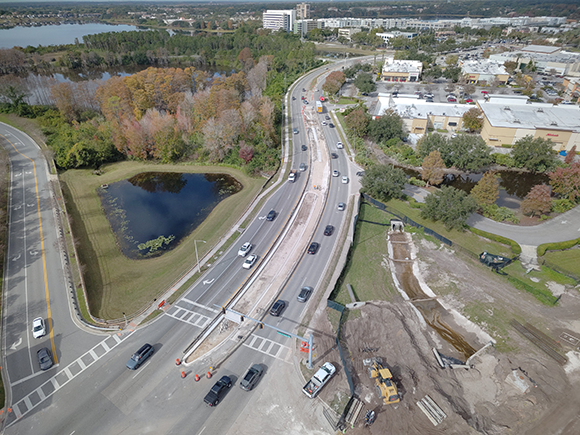
This month, construction crews completed milling and resurfacing work on the Interstate 4 (I-4) and U.S.
17-92
interchange project in Seminole County. The work took about two weeks to complete.
Milling and resurfacing are crucial steps to a roadway project’s success. Over time, roads are subject to
wear and tear
due to heavy traffic, harsh weather conditions, and natural aging of materials. This is where milling and
resurfacing play a pivotal role in maintaining and expanding the lifespan of roadways.
Milling is a technique in which the top layer of the pavement is removed using specialized machinery. This
process involves grinding down the surface to a predetermined depth, exposing the underlying layers of the
pavement. Milling serves many critical purposes like restoring the smoothness of a roadway, maintaining the
height of the pavement, salvaging recyclable materials, and improving drainage and overall safety.
Resurfacing involves applying a fresh layer of asphalt on top of a properly milled base. This essential
step in road maintenance breathes new life into roads. Resurfacing plays a major role in extending the life
of a road and improving ride quality, resulting in an overall smoother and more comfortable driving
experience for motorists and their passengers. It’s also a cost-effective option compared to a full road
reconstruction.
The I-4 and U.S. 17-92 interchange improvement project in Seminole County aims to enhance safety by
improving sight distance for motorists, upgrading crosswalks for pedestrians and bicyclists, and reducing
the speed limit on U.S. 17-92 from 50 mph to 35 mph. The improvements will include adding a
pedestrian-activated hybrid beacon signal at the end of the eastbound I‑4 exit ramp.
A pedestrian hybrid beacon (PHB) is a traffic control device consisting of two red lenses above a single
yellow lens. PHBs are designed to help pedestrians safely cross higher-speed roadways. They remain dark
until a pedestrian pushes the call button to activate a yellow-to-red lighting sequence consisting of
flashing and steady lights that direct motorists to slow and stop, providing the right-of-way to the
pedestrian to safely cross the roadway.
Additionally, an auxiliary lane will be added on eastbound U.S. 17-92 between the westbound I‑4 exit ramp
and Monroe Road. A second right turn lane will be added to U.S. 17-92 when driving east to continue south on
U.S. 17-92/Monroe Road. The dual right-turn-only lanes will stop at the signalized intersection at
Seminole Boulevard, replacing the existing free-flow right turn. A right turn lane will be added from
southbound U.S. 17-92/Monroe Road to the eastbound I‑4 entrance ramp, and a left turn lane will be added
from westbound Seminole Boulevard to U.S. 17-92/Monroe Road to drive south.
Construction started in fall 2023 and is expected to be complete by late 2024. To learn more about this
project, visit I4Beyond.com/U.S.17-92.
 Full post cycle from testing to live
 ATTENTION DRIVERS: Overnight Closures of Westbound I-4 Exit Ramp to Sand Lake Road (Exit 74A) February 9-11
 Overnight Turkey Lake Road Paving Operation January 14 – Mid February